
According to the Bitcoin Power Law Theory, Bitcoin (BTC) does not follow conventional financial or economic principles. Instead, its price and growth trajectory are shaped by power laws, making its behavior far more predictable than many assume.
This theory was developed by Giovanni Santostasi, a physicist and researcher, who argues that Bitcoin behaves less like a financial asset and more like a living organism or a city. Its price trends and the expansion of its ecosystem follow the mathematical patterns of power laws—bringing a surprising level of regularity, cyclicity, and long-term predictability.
Understanding Power Laws
Power laws, expressed mathematically as y = axⁿ, are common in nature and society. They describe systems where outputs continuously feed back as inputs, creating an iterative growth loop.
For example, consider how a pandemic spreads: at first, only a few people are infected. But each infected person can spread the disease to several others, and soon growth accelerates. The output (infected people) becomes the new input, producing exponential growth. Unless interventions occur, such as vaccines or lockdowns, the curve expands rapidly.
Bitcoin’s network functions in a similar way. Existing users attract new users, current hash power influences future mining, and overall growth compounds iteratively.
The growth of the Bitcoin ecosystem resembles the curve of a controlled pandemic—spreading according to a power law but moderated by interventions. Santostasi identifies a specific exponent: Bitcoin’s expansion seems to follow a power of three.
Why does this matter? Because identifying a repeating mathematical structure in Bitcoin’s growth allows researchers to model and anticipate long-term behavior.
Applying the Power Law to Bitcoin
Santostasi’s Bitcoin Power Law Theory suggests Bitcoin’s price can be forecast with remarkable precision. To understand this, we start with two key relationships:
Metcalfe’s Law
The value of a network grows proportionally to the square of its users. As more people adopt Bitcoin, its value scales as users².Mining Resources
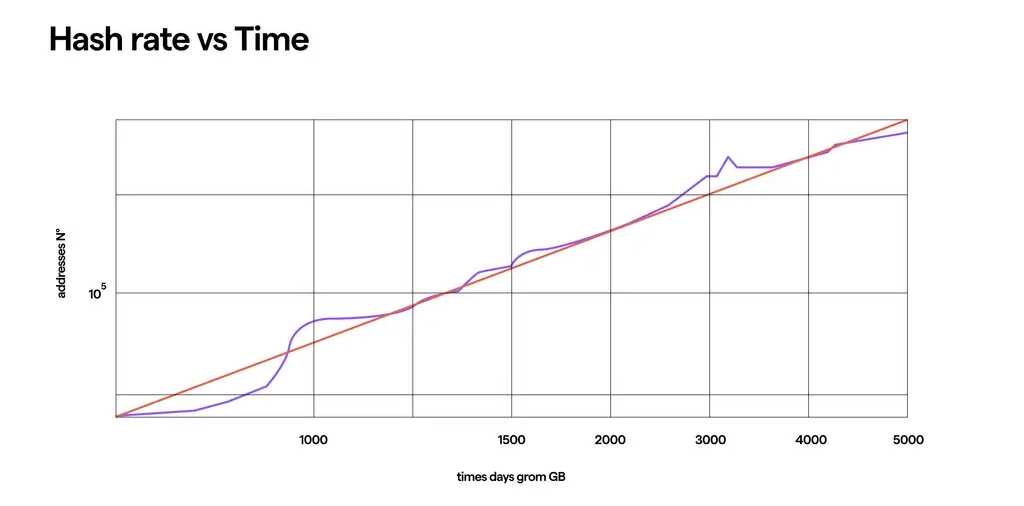
Bitcoin’s value also scales with the square of resources dedicated to mining. Rising prices attract more miners, which increases the global hash rate. Data analysis confirms this strong correlation between price and hash power.
Together, these feedback loops form the backbone of the Bitcoin Power Law.
Satoshi Nakamoto’s First Challenge
This self-reinforcing growth posed a problem for Bitcoin’s design: unchecked increases in hash power could have reduced block times dramatically, destabilizing the system.
Satoshi Nakamoto solved this with the difficulty adjustment mechanism. Every ~2 weeks, the network recalibrates mining difficulty to maintain a 10-minute average block time. As more miners join, difficulty rises—keeping issuance steady and the system sustainable.
This adjustment not only ensures stability but also enforces Bitcoin’s predictability.
Computing Power, Security, and Adoption
In Bitcoin, greater computational power equals greater security. Santostasi argues that higher security attracts more users, boosting adoption. While harder to measure directly, historical data supports this relationship: Bitcoin has never been hacked or broken, and this reliability continually attracts new participants.
In effect, Bitcoin’s unbroken security record creates confidence, which feeds adoption, which in turn increases value—a virtuous cycle entirely consistent with power law dynamics.
A Unique Growth Pattern: The Power of Three
Bitcoin’s adoption curve doesn’t resemble the classic S-shaped technology adoption curve (like smartphones). Instead, Santostasi identifies a power law with exponent three.
This means Bitcoin doesn’t simply grow exponentially or linearly—it expands in a fractal-like pattern that scales consistently across different magnitudes.
Consequences: Scale Invariance
One of the most fascinating aspects of the Bitcoin Power Law is scale invariance. This property means that no matter how large the numbers get, the underlying growth pattern stays the same.
Just like a fractal looks identical whether you zoom in or out, Bitcoin’s metrics—price, hash rate, active wallets—follow the same patterns regardless of whether BTC is worth $1 or $100,000.
According to this theory, even the recent capital inflows from Bitcoin ETFs fit naturally into this invariant framework: they were not accidents, but necessary reinforcements to sustain growth.
Fifteen Years of Predictable Scaling
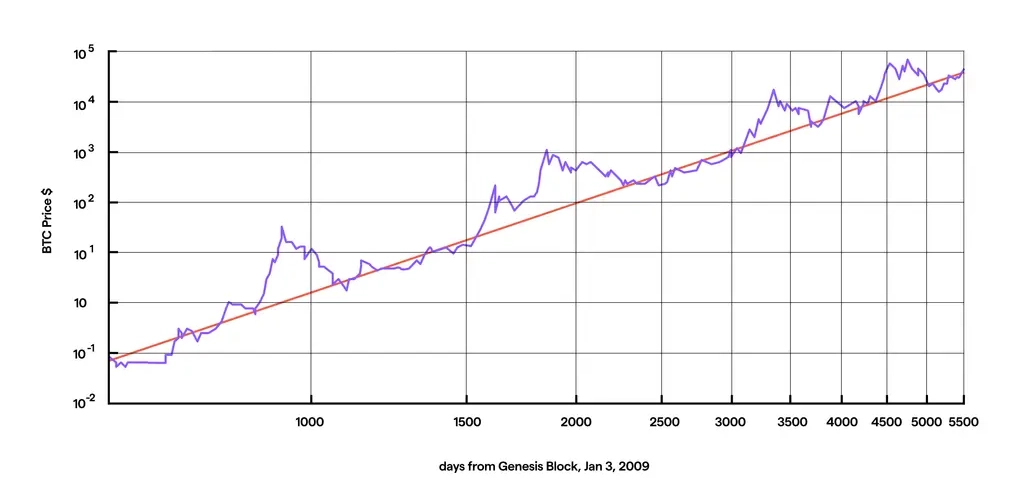
Over the past 15 years, Bitcoin’s price has scaled across multiple orders of magnitude (from <$1 to tens of thousands). Each order of magnitude fits into the power law model.
According to the theory, the next milestone—$1,000,000 per Bitcoin (10⁶)—could be reached within the next decade, following the same predictable trajectory.
Why Bitcoin’s “Bubbles” Fit the Model
Critics often call Bitcoin a bubble. In a sense, they’re right. But according to Santostasi, these cycles of boom and bust are not failures—they’re intentional features of the system.
Rising hash power increases security.
Rising security fuels confidence.
Confidence drives price spikes (FOMO).
Prices then collapse, resetting the cycle.
This mirrors punctuated equilibrium, a theory from evolutionary biology: long periods of stability interrupted by sudden bursts of change.
Satoshi anticipated this by combining difficulty adjustment with the halving cycle, ensuring miners stay just profitable enough to sustain the network without runaway inflation.
Each bubble, therefore, is not a threat but a growth mechanism. The Power Law predicts that these cycles are necessary to drive Bitcoin forward, balancing incentives while maintaining security.
It’s important to emphasize: the Bitcoin Power Law is still a theory. It should not be mistaken for an infallible formula that predicts prices down to the cent.
Yet, it remains one of the most compelling frameworks for understanding Bitcoin’s long-term dynamics. It reveals that beneath the chaos of price swings lies a surprisingly orderly and predictable structure.


